
Your complete business idea or business model
Turn a new service, operating model or digital business concept into a connected mobile product, backend and administration experience.
MOBILE PRODUCTS BUILT FOR REAL USE
Work with South African iOS and Android mobile app developers to turn a customer need, business workflow or product idea into a dependable custom app. Exceed IT helps with strategy, UI/UX design, development, backend systems, testing, store release and ongoing improvement.
Discuss your mobile appiOS and Android mobile app developers plan, design, build and test applications for iPhone and Android devices. The work includes the interface people use, connections to backend systems and preparation for distribution through the Apple App Store and Google Play. Exceed IT brings these activities into one delivery process for South African startups and businesses.
A mobile app makes sense when customers, employees or partners need to access your business regularly, on the move or through device features. Whether you need a booking app, customer app, field service app, delivery platform or internal business app, we start by understanding the problem and the user journey the app needs to solve.
A dependable app often needs more than the software installed on a phone. Customer accounts may need a secure API and database. Your team may need an administration dashboard to manage users, content, orders or exceptions. Notifications, analytics, payments and integrations each introduce operating responsibilities. We scope this complete system so that the visible app and the work behind it fit together.
WHAT WE CAN BUILD
We shape the product around your users and operating model. The examples below describe common app categories, not fixed packages; the agreed features depend on your business rules and first-release priorities.
Turn a new service, operating model or digital business concept into a connected mobile product, backend and administration experience.
Accounts, bookings, orders, loyalty, support and personalised information in a convenient mobile journey.
Jobs, forms, photos, signatures, location-aware tasks and offline capture for teams working away from a desk.
Connected customer, provider and administration workflows, including availability, status changes and payments.
Protected content, paid plans, recurring billing, account entitlements, notifications and access rules for subscription businesses.
A focused first release that tests the most important customer journey and business assumption before a broader product investment.
Live status updates, messaging, dispatch information, collaborative activity and timely notifications built around meaningful business events.
Nearby services, geofenced actions, location-aware content, maps and routing experiences designed around clear user permission and privacy choices.
Purposeful live or scheduled location tracking for deliveries, vehicles, assets or field teams, with agreed update frequency, background behaviour and battery use.
Collection, delivery, proof-of-service and timely status updates for customers, drivers and dispatch teams.
Your proposal identifies the deliverables included for your product. A project can combine:
Camera access, document upload, barcode scanning, biometrics, maps, location, push notifications and offline storage can make a mobile product useful. Each feature also needs permission handling, privacy decisions, fallback behaviour and testing. We include only the device capabilities that support a real user outcome.
The right approach depends on the experience, device capabilities, performance profile, team and long-term roadmap. We recommend a route after understanding those requirements rather than choosing a technology from a keyword.
| Approach | Often suits | Important considerations |
|---|---|---|
| Cross-platform app | Many business and consumer products that need iOS and Android from a shared product team. | Platform-specific behaviour, library support, native integrations and release testing still need deliberate attention. |
| Native iOS and Android | Products with demanding platform-specific experiences, deep device integration or an established native strategy. | Separate platform implementation can increase development, coordination and maintenance effort. |
| Progressive web app | Browser-accessible workflows where broad reach and simple distribution matter more than full native capability. | Device features, background behaviour and installation experience vary by browser and operating system. |
Native development uses platform-specific tools: Swift and Xcode are common choices for iOS, while Kotlin and Android Studio are common choices for Android. This approach gives teams direct access to each platform's APIs and interface tools. It can suit specialist device integrations or an existing native product, but two implementations require coordinated feature work and testing. A demanding feature should be assessed individually before deciding that the whole app needs separate codebases.
Both support cross-platform mobile development. React Native uses React with JavaScript or TypeScript and renders native platform UI components. Flutter uses Dart and its own widget and rendering system. Both can connect to native platform capabilities. The practical choice depends on your existing code, required integrations, interface needs and the team maintaining the product. Shared code can reduce duplicated work, but each app still needs platform-specific checks.
We commonly use React Native and Expo to create iOS and Android applications from a shared foundation. Shared code can improve delivery efficiency and consistency, but it does not mean every detail is identical across platforms. We account for platform conventions, permissions, device testing and store requirements. If a product needs a different approach, we explain the trade-off before development.
Read our native versus cross-platform comparison for a more detailed planning discussion.
For technical background, see the official React Native introduction and Flutter architecture overview.
Mobile UI/UX design starts with the task someone needs to complete: book an appointment, accept a job, scan a receipt or check an order. We map that journey before drawing individual screens, including what happens when information is missing or an action fails. A reviewable prototype helps you assess the flow before committing to development.
An app can share a brand and features while respecting different platform expectations. Apple's Human Interface Guidelines and Google's Material Design provide useful references for navigation, controls and feedback. We plan readable text, sufficient contrast, clear touch targets and screen-reader labels, then check the agreed journeys on representative devices. Keyboard behaviour, text resizing and permission prompts also affect whether people can finish a task.
For a booking app, choosing a time is only part of the experience. Users also need to understand availability, confirm the booking, recover from payment failure and find cancellation information. Reviewing these states early helps define a useful first release and reduces avoidable changes during the build.
Apps with shared accounts, bookings, orders or business records usually need a backend: the server-side system that stores information and applies business rules. An API lets the iOS and Android apps communicate with that system. Both platforms can use the same backend, keeping account details and shared records consistent across devices.
If you already have software, we review API documentation, authentication, access permissions, test environments and usage limits before estimating integration. We check whether the API supports the complete mobile workflow, including slow responses, retries and expired sessions. An existing website or database does not automatically provide every API an app needs.
If no backend exists, it can be scoped alongside the app. This may include a database, user roles, file storage, notification services and an admin dashboard. Your team may need to manage bookings, correct records or answer support queries. We agree which actions staff can take and which changes need an audit trail, so daily operations are part of the product plan.
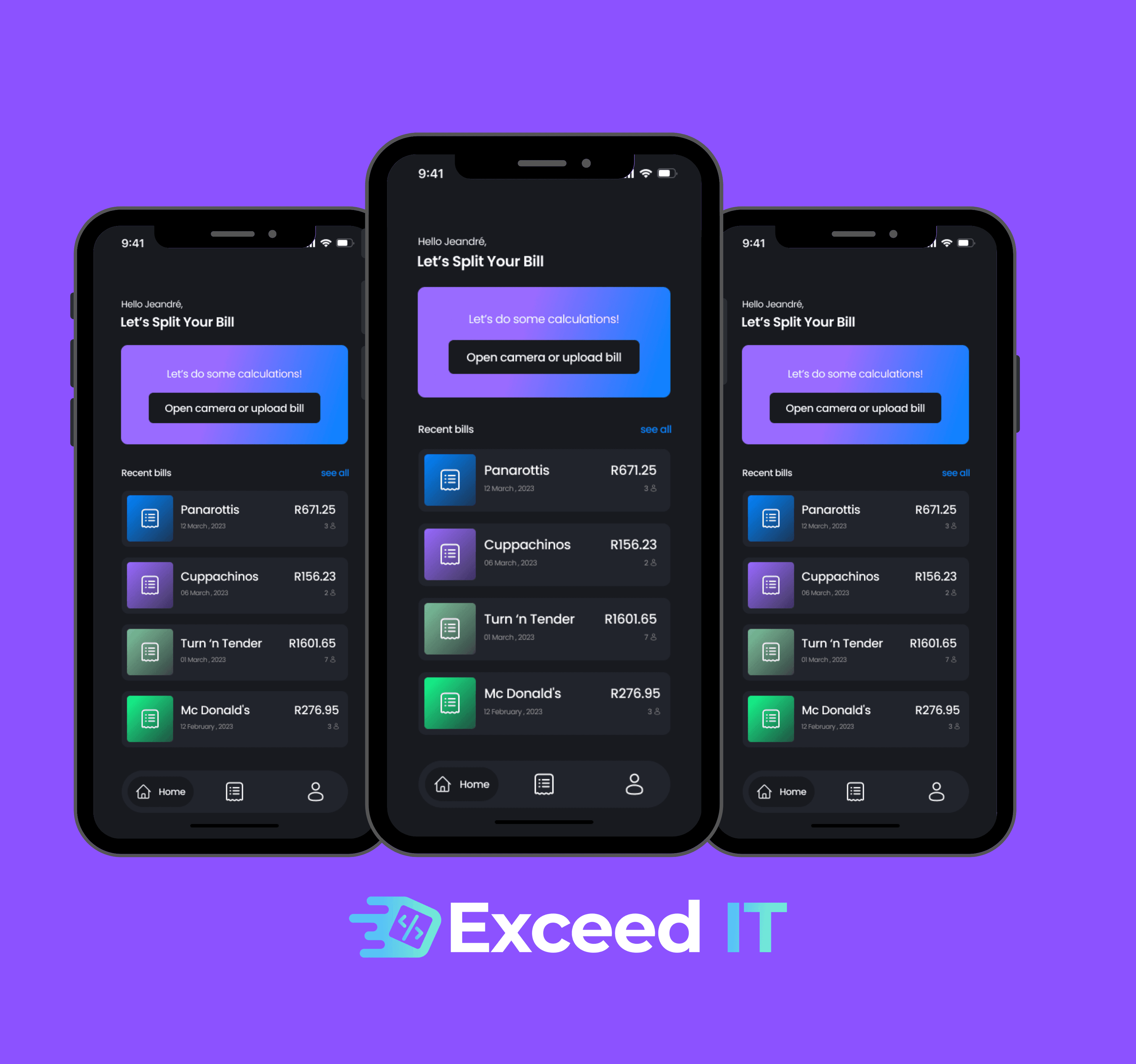
MOBILE APP BUILT BY EXCEED IT
Fair Share is a bill-splitting product available on the Apple App Store and Google Play. Its mobile journey brings receipt capture, item assignment and sharing together, supported by a custom system and administration capability.
The project demonstrates mobile interface development, camera-assisted input, shared records and the backend thinking needed to operate a consumer product. Explore the public project page and current store links as verifiable examples of our work.
Explore the Fair Share mobile app →Our app developers map users, complete journeys, business rules and operational needs before development begins. We use technologies such as React Native and Expo where suitable, while planning offline behaviour, permissions, APIs, payments, notifications, administration and release requirements from the start.
Define the users, business outcome, core journey and constraints. We examine device needs, connectivity, integrations, operational responsibilities and the evidence the first release should produce before recommending a platform.
Map the complete task for customers, employees and administrators. Wireframes and interface designs let you review navigation, content, errors, permissions and important edge cases before development makes those decisions costly to change.
Build the agreed app, backend and administration features in reviewable increments. Authentication, APIs, data storage, notifications and third-party services are developed around the product's actual workflows rather than added as disconnected features.
Test critical journeys across agreed iOS and Android versions, screen sizes and network conditions. We check permissions, interrupted actions, failed integrations, accessibility and release acceptance criteria with realistic data.
Prepare store information and release builds, support submission to Apple and Google, and agree production monitoring and support. Store approval remains controlled by each platform. Usage and support evidence inform the next release.
Mobile users change networks, deny permissions, close an app mid-task and use a wide range of devices. Acceptance testing should cover interrupted uploads, expired sessions, duplicate actions, failed payments, delayed notifications and synchronisation after an offline period where these scenarios apply. We agree supported devices and acceptance responsibilities in the project scope.
“Works offline” needs a precise definition. We identify which records are available without a connection, what users can change, how attachments are queued and what happens when two people edit the same information. Connectivity indicators and understandable synchronisation states help users know whether their work is safely stored.
Security requirements depend on the data and risk involved. Common controls include secure authentication, role-based access, protected transport, server-side validation, safe credential storage and dependency maintenance. We minimise requested device permissions and plan account deletion, data retention and privacy information around the agreed product requirements.
App development cost depends on the user roles, complete workflows, platform approach, integrations, data, administration tools and testing required. A focused booking app and a two-sided marketplace with payments, provider onboarding and dispute handling are different products even if both appear to have a similar number of screens.
We estimate after defining a useful first release. A proposal should distinguish discovery, design, application and backend development, testing and store preparation from recurring hosting, third-party services, store accounts, transaction fees and support.
Read our app development cost guide and quote comparison checklist before comparing suppliers.
A useful schedule separates discovery, design approval, development milestones, user acceptance testing and store submission. Each milestone should have a reviewable outcome, such as an approved prototype or a working booking journey. Integration access, payment-provider setup, content and feedback from your team can affect the delivery date as much as coding. We identify these dependencies when scoping the project and agree what must be ready before the next stage begins.
Prioritise one complete user journey and the administration needed to support it. For example, a service-booking MVP might need availability, booking confirmation and staff management before loyalty rewards or advanced reporting. Agree acceptance criteria and record new requests separately so their impact on cost and timing is visible. Our MVP development service helps shape this first release.
Release preparation can include production builds, signing configuration, store listing requirements, screenshots, privacy details and review support as agreed. Apple and Google control their review processes and may request information or changes; no developer can guarantee acceptance or an exact review time.
Your organisation should understand who owns the Apple and Google developer accounts, source repository, backend, domain, analytics and third-party services. We agree access and handover responsibilities before launch so that the product is not dependent on an unclear account arrangement.
Mobile operating systems, store policies and dependencies continue to change. Agree monitoring, backups, incident reporting, compatibility updates and how future features will be estimated. Support scope and response expectations should be documented rather than assumed.
Compare potential partners against the same scope and ask for evidence relevant to your product. A useful evaluation covers more than a list of technologies.
Exceed IT received TechBehemoths recognition for mobile app development in 2023 and 2024. Awards are one input; you should also review relevant work, speak to the proposed team and examine the delivery agreement. Learn more about Exceed IT and our published work.
Meet Jeandré van Zyl, Exceed IT's CEO and full stack developer, and read his published planning guidance. During your project discussion, ask who will handle design, development, testing and ongoing support, and how you will review progress with them.
Plan your first release with our free app development cost calculator. Compare feature costs, timeline, hosting and a five-year budget before requesting an official quote.
No. We can scope the backend, APIs and administration tools together with your mobile app. If you already have a backend, share its documentation and available test environment so we can assess authentication, required endpoints and integration gaps before estimating the work.
Start with the devices your intended users actually use. Launching on both platforms can suit a broad customer audience; a workforce app may initially need only the company's managed devices. A shared codebase can support a staged release, but each platform still needs testing and release preparation. We agree the launch order during discovery.
Describe your users, their main task, required platforms and essential first-release features. Include any designs, existing API documentation, device requirements and budget or deadline constraints. Identify who will approve designs and test the app. You can start with a plain-language brief; we help clarify missing requirements before estimating.
Yes. We develop apps for iOS and Android and can use a shared React Native codebase where suitable. We determine which features can share code and whether any functionality requires platform-specific development.
Yes. We build custom mobile apps around your business, users and workflows rather than forcing your requirements into a predefined template. This can include customer apps, booking systems, internal business apps, logistics platforms and other custom solutions.
Yes, selected parts of an app can be designed to work offline. We plan which information is stored on the device, how changes are synchronised when connectivity returns and how conflicting updates are handled.
Yes. Mobile apps can connect to payment providers, APIs, existing business systems, databases and other third-party services where suitable integration methods are available.
It depends on the product. Cross-platform development can suit many iOS and Android business apps, while native development may suit products with demanding platform-specific requirements. We assess the user experience, device features, performance, integrations and maintenance needs before recommending an approach.
A reliable timeline requires an agreed scope. User roles, integrations, offline requirements, design decisions, stakeholder feedback, testing and app-store review all affect delivery. We define milestones after discovery rather than promising one timeline for every app.
Yes. Store-release preparation and submission support can be included in the project scope. Apple and Google control their review processes, so approval and review timing cannot be guaranteed. We also agree who owns and manages the developer accounts.
Source-code ownership, licences, repository access, developer accounts, backend access and handover documentation should be explicit in the project agreement. We agree these responsibilities before development; third-party tools remain subject to their own terms.
Yes, after an assessment. We review the available source code, dependencies, backend, store accounts, data and known issues before recommending targeted improvements, staged modernisation or a rebuild.
The cost of app development depends on the number of features, user roles, integrations, platforms and complexity of the workflows. We recommend defining the core first release before estimating the complete development cost.
For a useful first conversation, share the intended users, their most important task, required integrations, any existing designs or software, and your budget and timing constraints.
You do not need a finished technical specification. We can help identify the next useful planning step and the information needed before an estimate.