
FROM THE EXCEED IT BLOG
Best Payment Platforms for Multi-Vendor Systems
Published
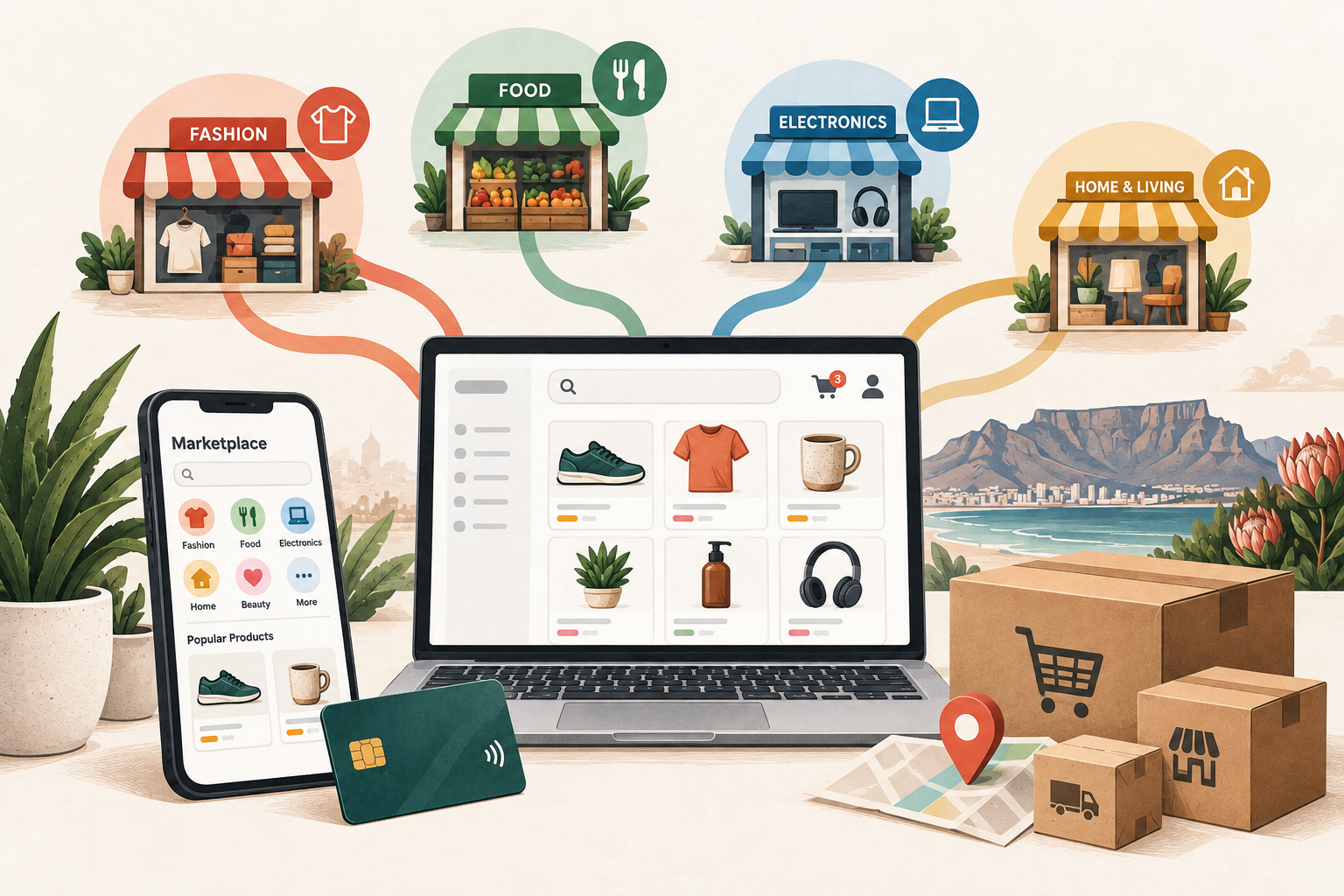
The best payment platforms for multi-vendor systems handle what happens after the customer pays. Your platform may need to keep a commission, pay a seller, refund one item or delay a payment until a service is complete.
This applies to delivery apps, ride-hailing services, booking sites, freelancer marketplaces and online shops with several sellers. A payment provider that works well for one shop does not automatically support collecting money for many businesses.
Quick answer: Paystack documents subaccounts and multi-split settlements. Payfast supports a split with one receiving merchant per transaction. Peach and Ozow provide separate payout APIs worth evaluating for later disbursements. Netcash has creditor-payment infrastructure. PayGate offers conditional card payouts. Yoco and Payflex should not be treated as full marketplace payout systems without specific supporting documentation and approval.
Research checked 24 September 2026. This guide compares documented capabilities and explains the questions to resolve with your provider. It does not certify a proposed marketplace's regulatory status.
Accepting, splitting and paying out are three different things
Accepting a payment means collecting money from the customer. For example, someone pays R1,000 for a cleaning service.
Splitting a payment means allocating that collection between recipients under the provider's supported arrangement. Your platform might earn R150 and the cleaner R850 before processing fees.
Sending a payout means instructing a separate outgoing payment. This might happen later, after the cleaner completes the job. The outgoing payment may use a funded provider balance and have its own fee and approval process.
Settlement is the provider paying collected proceeds to the agreed accounts. A split recorded now does not necessarily mean money reaches every bank account immediately.
The best payment platforms for multi-vendor systems must match the money flow your business promises. “We accept cards” does not answer “can we pay 200 different sellers on Friday?”
Follow one R1,000 order
For a 15% platform commission, the starting calculation is:
R150 plus R850 equals the customer's R1,000. But someone still pays processing costs.
Using Paystack's published local-card collection rate as an example, the fee is R30 before VAT and R34.50 including 15% VAT. If the platform bears that entire fee, the cleaner can receive R850 while the platform retains R115.50 from the collection. This excludes other charges and any tax treatment of the commission itself.
If the vendor bears the fee, their proceeds differ. Put the rule in your vendor agreement and your ledger. A ledger is the record of every amount collected, earned, refunded, owed and paid.
For three vendors in one basket, you need more than a “platform plus one seller” split. Either use an approved multi-split product or design an approved later-payout arrangement with separate vendor balances.
Compare marketplace capabilities
“Yes” means a function is documented. Merchant approval, eligible recipients and product terms still apply. “Contact provider” means the reviewed documentation does not establish the requested marketplace function.
| Provider | Split / multi-split | Recipient model | Outgoing payout API | Automation and settlement | Main limitation to resolve |
|---|---|---|---|---|---|
| Paystack | Yes / Yes | Subaccounts and split groups | Yes: bank transfers, including ZAR recipients | Split settlement and transfer status tools | Marketplace approval, fee bearer and refund recovery |
| Payfast | Yes / Limited | Main Payfast account plus one receiving merchant | Contact provider for separate vendor disbursement API | Split reflected in provider accounts; withdrawals separate | One receiving merchant per split transaction |
| Peach | Contact provider / Contact provider | Payout beneficiaries; confirm marketplace account structure | Yes: bank payouts | API or dashboard; status and report tools | Payout product does not itself establish multi-split checkout |
| Ozow | Contact provider / Contact provider | Payout recipients and funded float | Yes: separately approved Payouts API | API or bulk payout flow; bank rules apply | Approval and funding; not proof of connected seller accounts |
| Netcash | Contact provider / Contact provider | Creditor-payment records | Depends on product: outbound creditor service | Batch/business payment processes and statements | Confirm collection-on-behalf permission and release controls |
| PayGate | Contact provider / Contact provider | Eligible card payout recipient | Limited: CardPayoutRequest | Query final status; acquiring-bank support required | Card payout is not a verified multi-vendor bank-split system |
| Yoco | Contact provider / Contact provider | Merchant's own payout records in reviewed API | No vendor-send operation in reviewed payout API | Retrieval and reconciliation of merchant payouts | Reading a payout is different from creating a vendor payout |
| Payflex | Contact provider / Contact provider | Merchant purchase and instalment plan | Contact provider | Merchant settlement under agreement | BNPL checkout is not verified vendor payout infrastructure |
Sources: Paystack multi-splits, Payfast split docs, Peach payouts, Ozow payout onboarding, Netcash outbound payments, PayGate payouts, Yoco payout API and Payflex order API.
How the providers differ after checkout
Paystack: split settlement between registered recipients

A subaccount is a recipient record associated with a bank account. Paystack's split guide describes sharing settlement with a subaccount. Its multi-split guide extends that to more recipients and lets the integration define who bears fees.
This can suit a basket containing products from several vendors. The provider allocates settlement to the configured accounts, rather than requiring the platform to manually bank-transfer every share after collecting the entire amount into its own bank account.
For later transfers, its transfer API separately documents South African ZAR bank recipients. Confirm your account's approval and funding requirements. Creating a subaccount does not remove seller due diligence or settle the question of who is responsible for a refund.
Payfast: useful for one seller and one commission recipient

Payfast's developer documentation limits each split transaction to one receiving merchant. Its product explanation shows the collection reaching the main Payfast account and a predetermined portion moving to a secondary account.
This can fit one service provider per booking. It does not establish arbitrary multi-splits for a basket with five sellers. Decide which party is the main merchant and get approval for the arrangement. Both the accounting split and later bank withdrawals need to be explained to vendors.
Peach Payments: separate payouts for a later release
Peach's Payouts API can send bank payments and supports balance checks, status queries and reports. That makes it a candidate when a completed job triggers payment to a provider.
It is not, by itself, evidence that one checkout can automatically split among connected seller accounts. Confirm how collections fund the payout balance and who legally receives the original payment. Peach says payouts cannot be reversed and recommends verifying bank details before sending. See its payout overview and limits.
Ozow: funded payouts with separate onboarding

Ozow requires payout eligibility approval before issuing payout credentials. Its send-a-payout guide describes a server-side outgoing payment.
Payouts and refunds use a float: money available in the provider balance to fund outgoing transactions. You need to monitor it and plan how to replenish it. A successful customer payment is not automatically proof that a separate payout can already be funded. See float funding.
Netcash: creditor payments and business controls

Netcash's outbound services include creditor payments, which means paying businesses or people your company owes. Its gateway proceeds enter a Netcash account, from which separately enabled business payments can be made.
That is worth evaluating for an operational payment process with approval steps and batch releases. It is not a blanket promise of marketplace split settlement. Confirm seller onboarding, any bank-detail validation, who authorises batches and whether the proposed collection-on-behalf model is permitted.
PayGate: investigate the precise payout rail

PayGate documents a CardPayoutRequest, conditional on the acquiring bank or payment method supporting outbound transactions. It sends to eligible cards; it should not be labelled a universal bank-account payout product.
The guide also distinguishes an accepted request from a completed payout. That distinction matters when the vendor's screen says “paid”. Ask for a supported end-to-end marketplace design before building around this service.
Yoco: merchant payouts are not vendor payouts

Yoco's published Payouts API retrieves payout information. Its documented list/fetch operations help reconcile the merchant's own money. They do not establish an API for sending arbitrary payments to outside vendors.
Yoco may still suit a single business taking online and counter payments. For a marketplace, request specific documentation and approval rather than mistaking a merchant settlement feature for a multi-vendor feature.
Payflex: a buyer payment method within the wider design

Payflex lets eligible shoppers pay for a purchase in instalments. Its order API documents order outcomes and refunds, not a complete vendor balance and payout system.
If you offer BNPL on a marketplace, confirm who is the merchant and how a partial vendor cancellation changes the customer's instalment plan. The main marketplace payment arrangement still needs to handle each seller's earnings.
Compare collection costs and payout costs separately
Pricing last checked: 24 September 2026. Public collection fees do not constitute a marketplace quote. Ask about subaccounts, onboarding, outgoing payments, refunds, chargebacks and any reserve. A chargeback is a payment dispute that can result in money being taken back through the card system.
| Provider | Local-card collection reference | Bank collection reference | Outgoing or settlement reference | Monthly / additional cost |
|---|---|---|---|---|
| Paystack SA | 2.9% + R1 | 2% | Ordinary settlement free; bank transfers R3, including failed transfers | No base monthly fee; confirm marketplace terms |
| Payfast aggregation | 3.2% + R2 | EFT wording inconsistent; confirm | Standard withdrawal R8.70 | No base monthly fee; gateway quote separate |
| Peach Growth | 2.95% + R1.50 | 1.5% + R1.50 | Standard settlement free; separate Payouts quote | No base account fee; optional services extra |
| Ozow entry tier | 2.85%, minimum R1 | 1.5%, minimum R1 | Instant/bulk payouts R3 each | Contact provider; VAT wording unclear |
| Netcash | Contact provider | Contact provider | Quote creditor service separately | Contact provider |
| PayGate | Contact provider | Contact provider | Conditional card payout: contact provider | Contact provider |
| Yoco Core, lower volume | 2.95% + R2 | Contact provider | Standard merchant settlement free | Core R0; not a verified vendor-payout quote |
| Payflex direct | Quote chosen payment product | Contact provider | Quote merchant settlement; vendor payout unverified | Contact provider |
The clearly labelled Peach, Paystack collection, Payfast and Yoco rates exclude VAT. Confirm the VAT basis of Ozow's rates and Paystack's transfer charge before comparing them. Standard settlement, a transfer and an instant withdrawal are different services even if websites loosely call each a “payout”.
Payfast's EFT headline and worked example conflict, so it is not ranked by an assumed bank rate. Yoco's detailed Core schedule is used because some marketing pages omit the fixed online charge. Negotiated marketplace pricing can differ from all these public references.
What changes as the order grows?
At Paystack's local-card reference rate, with a 15% commission and the platform paying collection fees:
| Customer payment | Commission before costs | Card fee before VAT | Vendor share before other charges | Platform remainder after fee plus VAT |
|---|---|---|---|---|
| R100 | R15 | R3.90 | R85 | R10.51 |
| R1,000 | R150 | R30.00 | R850 | R115.50 |
| R10,000 | R1,500 | R291.00 | R8,500 | R1,165.35 |
These are planning calculations, rounded to cents. They exclude transfer fees, refunds, reserves and taxes on the underlying sale or commission. An arrangement where fees are shared needs a different calculation.
For later vendor payments, paying one vendor once for ten completed jobs may incur fewer transfer fees than ten separate transfers. Only batch where your provider contract and vendor payment promise allow it; delayed payment has a real cost to the vendor too.
Decide who receives and controls the money
Before selecting the best payment platforms for multi-vendor systems, draw the bank accounts and provider balances involved. Ask these questions in writing:
- Who is the merchant shown to the customer and on the receipt?
- Does the provider settle directly to each vendor, or does all money first reach the platform?
- Can the platform delay release, and for how long?
- Who handles customer disputes and pays any negative balance?
- What seller verification must happen before trading or payout?
- What happens when a seller leaves with refunds still possible?
KYC, or know your customer, means identity and business checks. FICA is South Africa's Financial Intelligence Centre Act, which underpins relevant anti-money-laundering obligations. The provider's onboarding team should specify the checks, documents and responsibilities for your model. A bank-account number alone is not a complete vendor onboarding process.
The South African Reserve Bank identifies and regulates different participants in the payment system, including third-party payment providers. A software platform collecting and distributing money needs a structure that fits its actual role. Get the provider and appropriate advisers to confirm it before launch. See SARB payment-system regulation and the Financial Intelligence Centre.
Do not call a delayed payout “escrow” merely because your software has a hold button. Holding customer money, operating stored balances and collecting for sellers can introduce obligations that an ordinary merchant account does not cover.
Design refunds before sending the first vendor payout
Suppose a R1,000 job is fully refunded after the vendor received R850. The customer needs R1,000 back, but that money is no longer all in the platform's balance.
Your agreement and software must explain how the vendor's share is recovered, whether the commission is reversed, and who absorbs non-refundable processing costs. A refund is not necessarily an automatic reversal of the earlier split or bank payout.
For a R200 partial refund, reversing a 15% commission proportionally would mean R30 from the platform's commission and R170 from the vendor's earnings, before fee treatment. That is an example business rule. Configure it explicitly and check provider support; do not assume it happens automatically.
Useful controls include a clear payout-release date, an agreed reserve where permitted, and a way to prevent further payouts while a vendor owes money. The purpose is to keep the customer refund and vendor statement consistent, not to conceal a shortfall.
Reconciliation: make every rand explainable
The marketplace needs to link each order to its customer payment, commission, vendor allocation, refund and payout. Give every outgoing payment a unique reference and keep its status.
An API is the software connection used to request actions. A webhook is the provider's automatic status message. Neither an accepted API request nor a customer return screen necessarily proves that money reached the destination.
Keep “requested”, “pending”, “paid”, “failed” and “returned” distinct. A retry must not create a second vendor payment. Recheck uncertain transactions using the original reference before starting a new instruction. Paystack discusses references in its transfer guide, and Ozow explains final versus intermediate states in its status guide.
Give vendors a statement showing opening balance, earned sales, commission, fees, refunds, payouts and closing balance. A total labelled “earnings” is not enough when the bank deposit is a different amount.
Frequently asked questions
Which are the best payment platforms for multi-vendor systems with several sellers per basket?
Paystack explicitly documents multi-split settlement. Payfast's documented split is limited to one receiving merchant per transaction. For a later-payout design, compare approved Peach, Ozow or Netcash services and confirm the complete money flow.
Can we collect everything and manually EFT the sellers?
That may be technically possible, but technical possibility is not approval. Confirm the collection-on-behalf arrangement, record every seller's balance and use controlled payment approval. Manual transfers still need reconciliation and refund recovery.
Does a payout API mean a provider supports marketplaces?
No. It proves an outgoing-payment function exists. Marketplace onboarding, allowed fund flows, seller checks and settlement rights still need confirmation. Yoco's published payout API is an especially useful reminder: some payout APIs only retrieve records.
What if vendors also pay a monthly platform subscription?
That is a separate billing flow. Read our SaaS payment guide for recurring collections. Use a separate ledger entry for the subscription rather than silently deducting it from sales without agreement.
For the buyer's journey, read mobile app payment platforms or ecommerce checkout options.
Choose the money movement before building vendor balances
The best payment platforms for multi-vendor systems support a clear, approved route from customer payment to vendor receipt, including fees, refunds and failures. Start with one order and follow every rand through the whole lifecycle.
Exceed IT builds custom platforms and payment integrations. Discuss your marketplace with our team to map commissions, vendor balances, refunds and payouts before development begins.
Sources and review notes
Primary sources are linked beside each provider and fee claim. Further reading: Paystack transaction splits, Payfast merchant FAQs, Peach payout reports and balance API, and Netcash gateway account flow. Unverified multi-vendor capabilities are labelled for confirmation instead of being inferred from ordinary checkout support. Logos remain the property of the respective providers.